


Ultrasound Technique Visualizes Deep Blood Vessels in 3D Without Contrast Agents
Posted on 09 Dec 2025
Producing clear 3D images of deep blood vessels has long been difficult without relying on contrast agents, CT scans, or MRI. Standard ultrasound typically provides only 2D cross-sections, limiting clinicians’ ability to visualize full vessel structures. More advanced modalities introduce risks such as radiation exposure, kidney-damaging contrast agents, high costs, or bulky equipment. A new technology now addresses this challenge by generating real-time 3D vascular images up to 7 cm beneath the skin without contrast or radiation.
Researchers at Daegu Gyeongbuk Institute of Science and Technology (DGIST, Daegu, South Korea) have developed an ultrasound imaging system that visualizes deep blood vessels in three dimensions using a compact, simplified architecture. The research team integrated a Row-Column Addressed array—an approach that reduces thousands of hardware channels—with plane-wave compounding to synthesize images from multiple angles. They further enhanced sensitivity using coded excitation, a signal-boosting technique that improves clarity without increasing device complexity.
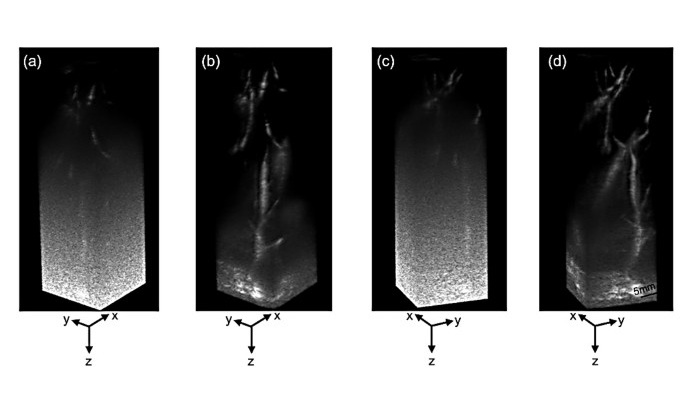
During testing, the system produced high-resolution 3D images of vessels located approximately 7 cm beneath the skin, all without contrast injections. It also captured real-time blood-flow motion in the liver and spleen of a healthy adult at 27 frames per second. These results, published in Ultrasonics, demonstrate image quality on par with more complex systems, while maintaining the portability and safety advantages of ultrasound.
The technology’s ability to visualize deep vascular structures in 3D opens pathways for safer diagnostics and continuous monitoring of internal organ disease. Its simplified hardware design makes it more feasible for clinical deployment, particularly where cost, equipment size, or patient safety prohibit CT or MRI. Future development at DGIST aims to adapt this platform into medical devices suitable for routine clinical use.
"This is a significant achievement that demonstrates the ability to observe deep blood vessels in 3D without complex equipment or contrast agents," said Professor Yoo Jae-seok, senior researcher on the study. "It can be immediately applied to the non-invasive diagnosis and monitoring of deep organ diseases."
Related Links:
DGIST