


Advanced MRI System Detects Impaired Cardiac Oxygen Use in Minutes
Posted on 31 Mar 2026
Early identification of cardiac dysfunction remains challenging because current methods to evaluate myocardial oxygen use are invasive or impractical for routine care. Delays in detecting impaired oxygen utilization can hinder timely management of heart failure, which affects nearly 7 million people in the U.S. To help address this challenge, researchers at Cedars-Sinai Health Sciences University (Los Angeles, CA, USA) have developed a magnetic resonance imaging (MRI) system to streamline assessment of cardiac oxygen use. A new study shows the approach could enable earlier, noninvasive evaluation in clinical settings.
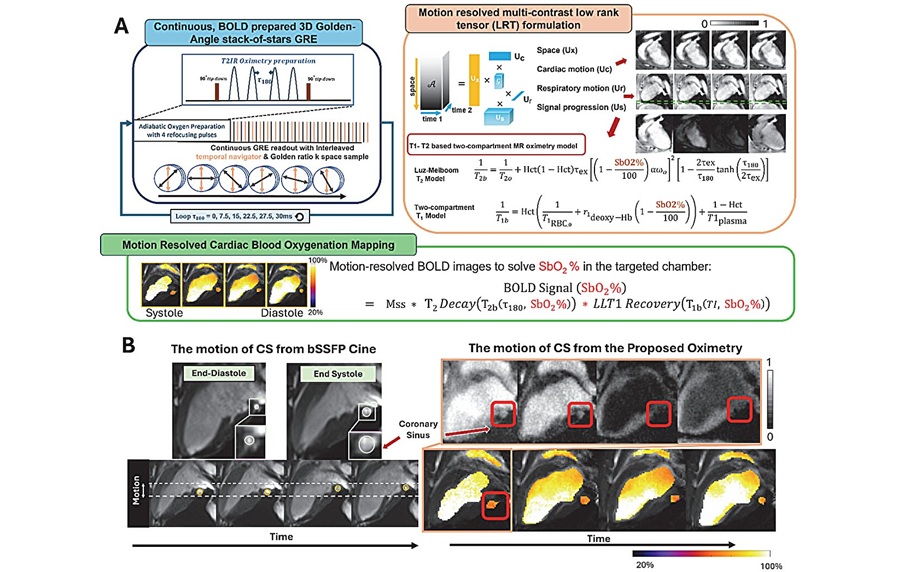
The system is a free‑running, motion‑resolved three‑dimensional MRI oximetry framework for coronary sinus blood oxygenation mapping. It is designed to quantify myocardial oxygen consumption and efficiency with motion‑resolved cardiac MRI. Developed at Cedars‑Sinai, the system aims to provide objective measurements of cardiac oxygen use compatible with routine workflows.
Current clinical assessment relies on coronary sinus catheterization to measure heart oxygen use. The procedure threads a catheter from the neck or groin into the heart’s main vein, takes 30 to 60 minutes, and requires contrast dye to guide placement. Because it is invasive, it is not suitable for routine monitoring in patients at risk of heart failure.
Standard MRI also has limitations for metabolic assessment. Clear cardiac images typically require repeated breath‑holds, and measuring oxygen has required multiple scans over several minutes with simultaneous blood sampling. The Cedars‑Sinai system addresses cardiac motion, eliminates the need for breath‑holding, and provides precise numerical results in approximately three minutes.
The research team evaluated the method by measuring cardiac oxygen use in patients with and without heart failure and comparing MRI‑derived readings with catheterization results. This approach demonstrated accuracy against the invasive reference standard. The findings were published in Science Translational Medicine on March 25, 2026.
Noninvasive measurement of impaired cardiac oxygen use is highlighted as an early warning of developing heart failure. Earlier detection could support prevention and treatment strategies as new cardiometabolic therapies become available. The investigators also noted potential research applications, including study of at‑risk but asymptomatic individuals without exposure to catheterization, contrast, or radiation.
“Our study shows how MRI could be used to quickly and noninvasively determine heart oxygen use in the clinic,” said Hsin-Jung Yang, Ph.D., director of Cardiac Imaging Research in the Biomedical Research Imaging Institute and corresponding author of the study. “With further research and development, this advance could unlock new frontiers in early diagnosis, personalized therapy and next-generation treatments for heart failure.”
“Along with its potential for saving lives through early intervention for heart failure, this accessible tool could offer new avenues for cardiac research,” said David Underhill, Ph.D., chair of the Department of Biomedical Sciences. “It could allow us to study patients who have risk for, but no symptoms of, heart failure without exposing them to catheterization, contrast or radiation.”
Related Links
Cedars-Sinai Health Sciences University