


MRI Scan Breakthrough to Help Avoid Risky Invasive Tests for Heart Patients
Posted on 06 Feb 2026
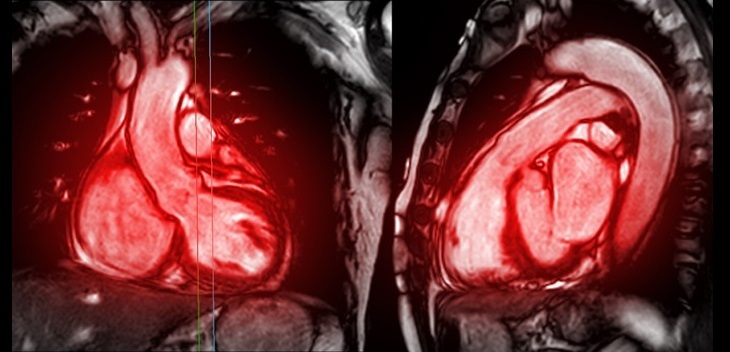
Heart failure patients often require right heart catheterization to assess how severely their heart is struggling to pump blood, a procedure that involves inserting a tube into the heart to measure blood oxygen levels. While clinically valuable, the test is invasive, uncomfortable, and carries risks, particularly for older, frail, or critically ill patients. Researchers have now shown that the same vital information can be estimated safely and non-invasively using a routine heart MRI scan.
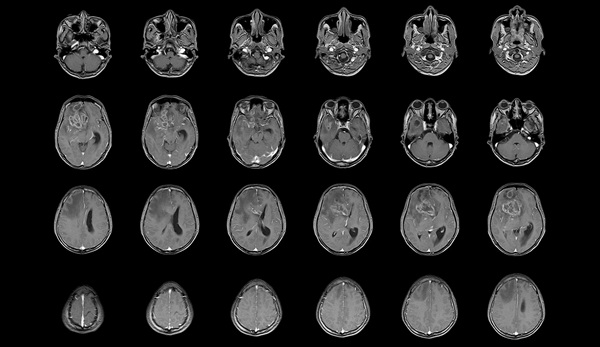
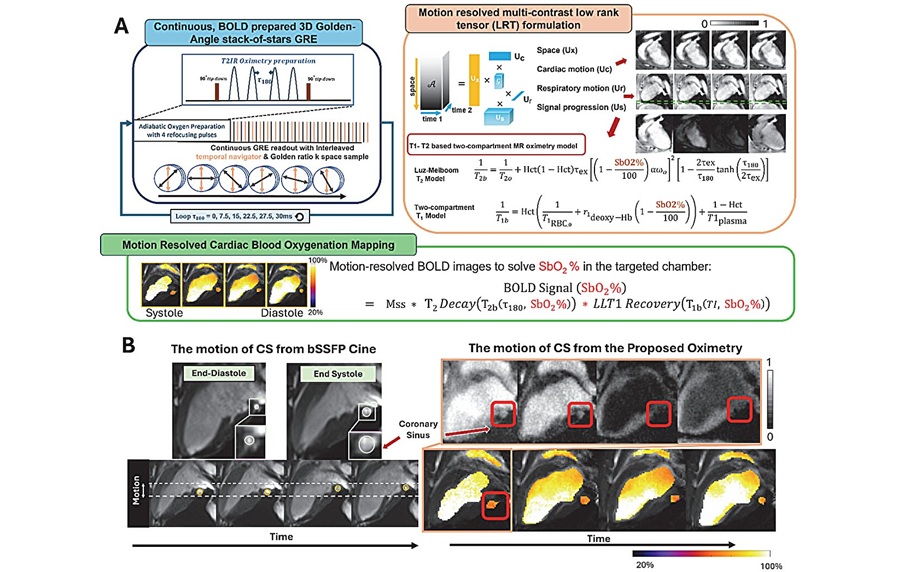
In collaborative research led by the University of East Anglia (Norwich, UK), the team focused on replacing invasive catheter-based oxygen measurements with data derived from standard cardiac MRI. Using a commonly available MRI technique known as T2 mapping, they developed a formula that estimates how much oxygen remains in blood returning to the heart, a key marker of heart failure severity.
The method works by exploiting how blood with different oxygen levels behaves in a magnetic field. By measuring subtle changes in MRI signals, the researchers were able to predict mixed venous oxygen saturation without inserting catheters or drawing blood. Importantly, the technique requires no additional hardware, no contrast dye, and adds only seconds to a routine cardiac MRI scan.
The researchers first validated the approach in 30 patients by directly comparing MRI-based estimates with catheter readings, finding close agreement between the two. They then applied the method to 628 patients with newly diagnosed heart failure and followed them for nearly three years. Patients with healthier MRI-derived oxygen readings were significantly less likely to die or be hospitalized.
The findings, published in JACC Advances, show that MRI-based oxygen measurement remained a strong predictor of outcomes even after accounting for age, other illnesses, and overall heart function. This suggests the method could be used to assess risk, guide treatment decisions, and enable safer repeat monitoring over time. Researchers believe the approach could spare thousands of patients from invasive testing and plan further studies to confirm its usefulness across different hospitals and patient groups.
“One of the most important markers in advanced heart failure is how much oxygen is left in blood returning to the heart,” said Professor Pankaj Garg, lead author of the study. “Our study shows this can now be estimated non-invasively from a standard heart MRI, potentially transforming how we assess and monitor heart failure.”
Related Links:
University of East Anglia