


Wearable Ultrasound Sensor Delivers Noninvasive Treatment Without Surgery
Posted on 17 Dec 2025
Wearable ultrasound devices have long struggled with low acoustic power and poor structural stability, limiting their use in high-resolution imaging and therapeutic applications. Conventional flexible sensors often fail to focus ultrasound precisely or maintain performance when bent to match the body’s contours. A newly developed approach now enables a body-conforming ultrasound sensor that preserves high output and stable performance while delivering focused ultrasound for imaging and therapy.
Researchers at Korea Advanced Institute of Science and Technology (KAIST, Daejeon, South Korea) used microelectromechanical systems fabrication to create a capacitive micromachined ultrasonic transducer that can switch between flexible and rigid states. The device integrates a low-melting-point alloy within its structure. When electrically heated, the alloy softens, allowing the sensor to bend freely; once cooled, it solidifies and locks the device into a fixed curved shape tailored to the target anatomy.
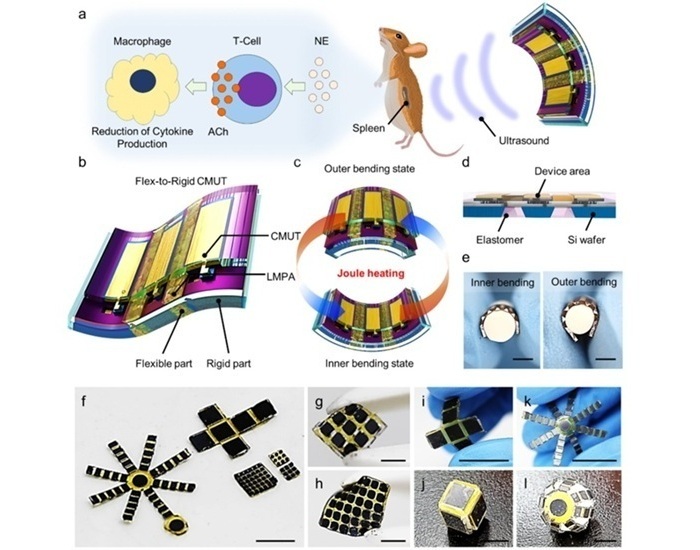
Unlike polymer-based ultrasound membranes that suffer from low stiffness and weak acoustic output, the new design combines a rigid silicon substrate with a flexible elastomer bridge. This hybrid architecture enables strong ultrasound emission while still allowing mechanical adaptability. By adjusting curvature directly within the device, the sensor can focus ultrasound energy automatically without relying on complex beamforming electronics, simplifying system design and improving reliability during repeated bending.
Performance testing showed that the sensor maintains stable electrical and acoustic characteristics even after multiple flexing cycles. Its acoustic output reaches levels consistent with low-intensity focused ultrasound, suitable for safe therapeutic stimulation. Results of animal experiments, published in npj Flexible Electronics, demonstrated that targeted, noninvasive ultrasound stimulation of the spleen reduced inflammation and improved mobility in arthritis models.
The combination of high-resolution imaging capability and therapeutic ultrasound delivery opens new opportunities for wearable medical systems, including long-term monitoring and home-based treatment. Because the technology is compatible with standard semiconductor manufacturing, it can be mass-produced at scale. Future work will expand the design into two-dimensional sensor arrays, enabling simultaneous imaging and therapy and supporting the development of next-generation smart, wearable ultrasound platforms.
Related Links:
KAIST