


CT-Derived Biomarker Predicts Outcomes in Gastric Cancer
Posted on 19 Jun 2026
Gastric cancer, also known as stomach cancer, is the fifth most common malignancy worldwide and often shows heterogeneous outcomes even within the same stage. Prognostic estimates typically rely on tumor-centric staging, which may miss patient-level metabolic and inflammatory risk. More precise stratification could help tailor perioperative therapy and follow-up. Researchers have now developed a tomography-derived biomarker that aims to refine prognosis for patients with gastric cancer.
Investigators at the State University of Campinas (UNICAMP) in São Paulo, Brazil, identified a new marker called VMD by analyzing routine computed tomography (CT) images from patients treated at the institution. The study was conducted by the Department of Radiology and Oncology at the Faculty of Medical Sciences in collaboration with the Gleb Wataghin Institute of Physics. The marker is designed to complement conventional staging and support more personalized treatment planning.
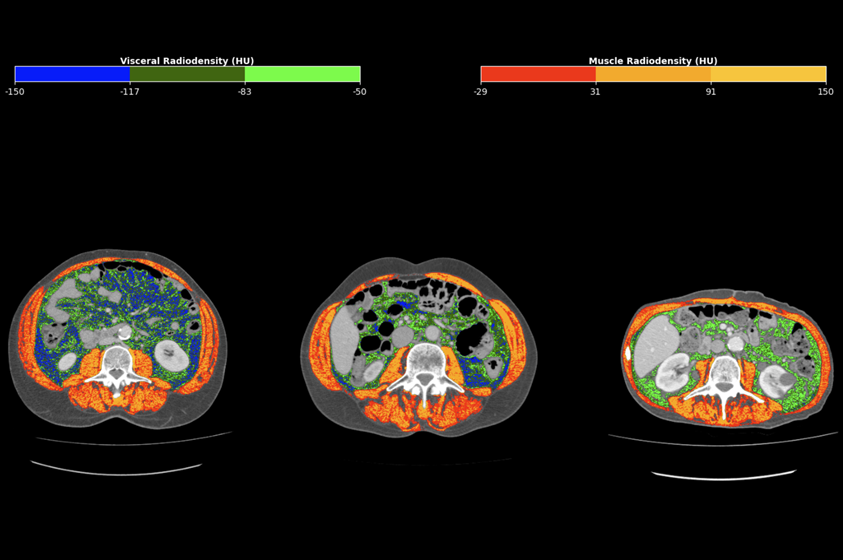
VMD combines radiodensity values from visceral adipose tissue and skeletal muscle measured on CT. Radiodensity reflects X‑ray attenuation and captures tissue changes linked to cancer-associated inflammation and metabolism. Using the difference between fat and muscle helps mitigate inter-scanner calibration variability and improves marker robustness.
The team applied artificial intelligence (AI) and machine learning to evaluate large volumes of imaging, clinical, and laboratory data. They tested multiple variable combinations to derive a formula that best separates higher- and lower-risk profiles. Results were published in Clinical Nutrition ESPEN.
In a retrospective analysis of 461 gastric cancer patients treated at UNICAMP over nearly 10 years, higher VMD values identified individuals at greater risk of unfavorable progression. These patients had worse overall and disease-free survival, with median survival of 13.8 months in the worst indicators group compared with 58.5 months in those with lower VMD values. The marker differentiated outcomes by integrating adipose and muscle radiodensity patterns.
Clinically, VMD could eventually aid therapeutic stratification, including identifying who might benefit from chemotherapy after surgery and who might avoid more toxic regimens. Because it leverages CT scans already used in routine care, it may expand actionable information without new tests. The authors note that these findings require external validation, ideally in prospective, multicenter studies, and they are testing the approach in other cancers. Whether nutritional interventions can modify this body profile remains unknown.
“Today, cancer treatment is still very tumor-centric. Our proposal is to look at the patient as a whole. That's a line of research that Professor José Barreto has been developing for years. That's what convinced me to participate. It isn't enough to treat the disease; you have to treat the patient,” said Jun Takahashi, full professor at IFGW-UNICAMP and co-adviser of the study.
“We believe that nutritional therapy can help improve the patient's condition, but that wasn't evaluated in the study. We still don't know if it's possible to change that profile and impact the prognosis by doing so. We have the question, but not yet the answer. That still needs to be investigated,” said Maria Carolina Santos Mendes, nutritionist and co-adviser on the study.
Related Links
UNICAMP