


AI Tool Flags Osteoporosis Risk from Routine Chest X-Rays
Posted on 03 Jun 2026
Osteoporosis is a progressive loss of bone density that is often silent until a fracture occurs. Current screening frameworks concentrate on older women and select high-risk groups. Many men, younger adults, and people with normal body mass index receive no routine assessment despite clinically meaningful risk. To help close this gap, researchers have developed an artificial intelligence approach that analyzes existing chest radiographs to flag undiagnosed bone loss before injury.
Developed by St. Paul’s Hospital (Taoyuan, Taiwan) and National Taiwan University (Taipei, Taiwan), the system repurposes routine chest X-rays obtained during health examinations to identify imaging patterns associated with low bone mineral density. It uses the radiograph as an opportunistic screening tool and then directs flagged individuals to dual-energy X-ray absorptiometry (DXA) for confirmation. The work is reported in npj Digital Medicine.
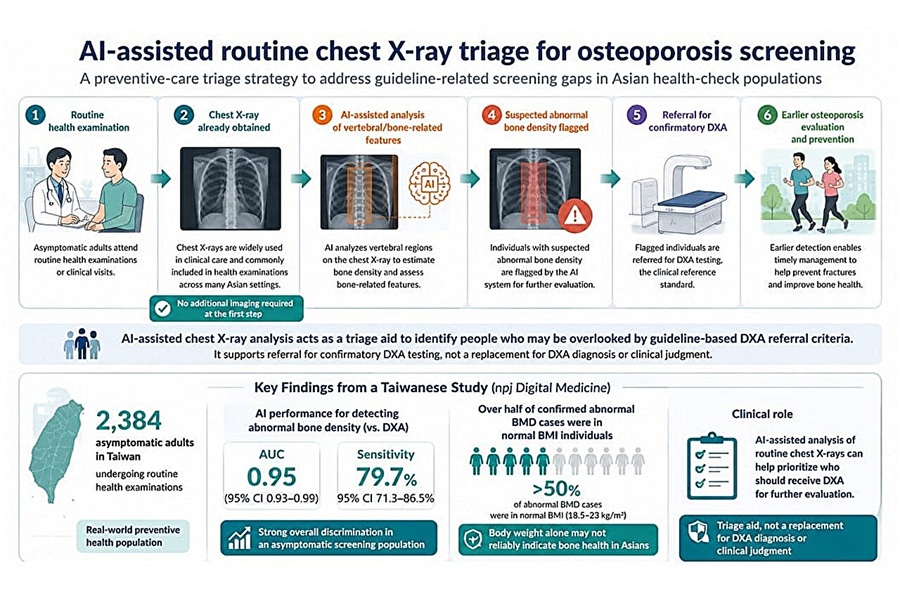
Because chest radiography is already ubiquitous in health checks across Asia, the approach adds no new imaging, scheduling, or patient burden. It is designed to extend screening reach into populations that current criteria exclude. In practice, it can highlight at-risk men and younger adults who would otherwise remain outside guideline-based pathways.
In the study, more than half of confirmed abnormal bone-density cases occurred in people with a normal body mass index. This finding exposes a major blind spot created by traditional, risk‑factor‑only screening strategies. By uncovering silent bone loss in ostensibly healthy‑weight individuals, the method advances diagnostic equity while preserving existing clinical workflows.
"Under Taiwan's National Health Insurance system, we often rely on strict guideline-based criteria to decide who qualifies for DXA testing," said Shu-Han Chen, MD, first author of the study, a family medicine physician, leader of the Health Management Center at St. Paul's Hospital, and an alumnus of the Graduate Institute of Health Policy and Management at National Taiwan University. "Our findings suggest that AI-assisted chest X-ray analysis could help identify individuals who may otherwise be overlooked and who may benefit from confirmatory DXA testing."
"This study demonstrates how artificial intelligence can transform existing health care workflows into scalable preventive-health strategies while supporting more equitable access to osteoporosis screening," said co-corresponding author Prof. Ray-E Chang at the Institute of Health Policy and Management at National Taiwan University.
Related Links
National Taiwan University