






Nuclear Medicine
Risk Factors for Contrast-Induced Nephrotoxicity Debated
Conflicting with current belief, a new study finds that patients with a history of diabetes are not one of the most at risk for contrast-induced nephrotoxicity. Instead, the study revealed that patients with a history of renal disease, hypertension, and/or heart disease are more likely to suffer from renal insufficiency, putting them at greater risk for contrast-induced nephrotoxicity. More...18 May 2012
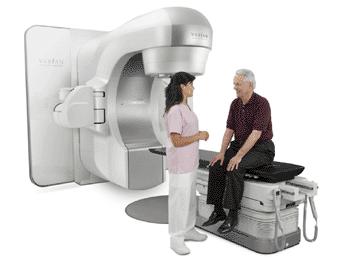
Stereotactic Radiosurgery Effective Within Standard Time Slots
A highly precise and noninvasive way of excising tumors using carefully shaped high-energy X-ray beams can be performed quickly and accurately in the treatment of tumors of the brain, spine, thorax, and gastrointestinal tract. More...16 May 2012
Stereotactic Radiosurgery Enables Effective, Noninvasive Treatment for Spinal Tumors
Leading experts in radiosurgery of the spine recently presented data during a US neurosurgical meeting about how to treat spinal tumors effectively using stereotactic radiosurgery instead of invasive surgical procedures. More...24 Apr 2012



X-Ray Illuminator
X-Ray Viewbox Illuminators

MRI System
nanoScan MRI 3T/7T

Mobile X-Ray System
K4W


Computed Tomography System
Aquilion ONE / INSIGHT Edition
In Other News
Early PET Response to Chemo Predicts Survival in Sarcoma Patients
Molecular Imaging Reveals Systemic Inflammation Tied to Depression
PET Imaging Approach May Restore Motor, Cognitive Function in Parkinson’s Disease
PET Amyloid Imaging Agent Shows Promise for Alzheimer’s Detection
Radioactive Antibody Fragment Used as Tracer to Identify Artery Deposits
Endoscopic Molecular-Guided Surgery Eradicates Cancer
Adding Breast-Specific Gamma Imaging to Breast Imaging Centers Improves Breast Cancer Detection
Fat-Enclosed Nanoparticles Designed to Effectively Irradiate Brain Tumors
Proton Therapy System Powered by Triniobium Core
Women with Breast Pain Not Likely to Benefit from Breast Imaging
Radiotherapy Still Used in Some Older Breast Cancer Patients, In Spite of Little Benefit
PET Tracer Imaging Changes Brain Tumor Management Plans
Radiotherapy Surface Beacon Transponder Designed for Real-Time Tracking
First Adaptive Radiotherapy Trial Initiated for Head and Neck Cancer Patients
Older Lung Cancer Patients Survival Not Improved by Postoperative Radiotherapy
Molecular PET-CT System Provides Precise Measurement of Metabolic Processes and Data Quantification
Molecular Breast Imaging May Be Better Than Ultrasound and Mammography for Breast Cancer Detection
For Problematic Breast Cancer Cases, PET Techniques Offer More Accurate Diagnosis, Prognosis
Proton Treatment Center Established in Saudi Arabia
Head and Neck Cancer Recurrence Detected Earlier by Follow-Up PET/CT
Lifelong Brain-Stimulating Practices Leads to Lower Alzheimer’s Protein Levels
Noninvasive Fluorescent Molecular Imaging Probes Identify Lymph Node Metastasis
PET Imaging Agent Has Potential for Diagnosing Alzheimer’s Disease


The Nuclear Medicine channel of MedImaging brings the latest in research and clinical radiotherapy, proton therapy, PET-CT, SPECT, SQUID, radiopharmacology, scintillography, trends and safety concerns.