


Portable Ultrasound System Monitors Brain Blood Flow
By Daniel Beris
Posted on 16 Nov 2016
A fully portable, transcranial Doppler (TCD) diagnostic ultrasound system assesses blood vessels in the brain in order to facilitate rapid triaging and monitoring of patients with brain disorders.Posted on 16 Nov 2016
The Lucid M1 TCD ultrasound system is a battery-operated, medical-grade tablet device designed to non-invasively measure and display cerebral blood flow velocity over the head and neck using a reusable, non-sterile 2-MHz hand-held probe. It can also be used to perform bilateral cephalic monitoring by monitoring blood flow velocity in the temporal window, using a headset equipped with a pair of monitoring transducers.
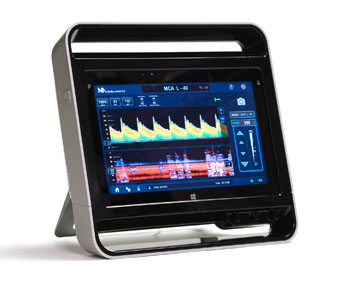
Image: The Lucid M1 transcranial doppler ultrasound system (Photo courtesy of Neural Analytics).
Clinical measurements include maximum velocity, mean velocity, minimum velocity, pulsatility index, cerebrovascular reactivity, and emboli count. The system can be moved easily throughout a medical facility in a range of settings that require the rapid assessment of blood flow in the brain to expedite treatment. Many significant cerebral disorders, such as severe traumatic brain injury (TBI), are caused by blood flow disruption.
A unique feature of the Lucid M1 system is a modified M-mode display, which is a presentation of standard M-mode display information in a signal “strength versus depth” format. Using the modified M-mode display, the operator can quickly acquire the spectrogram signal and therefore perform a faster exam. Using this feature, the M-mode signal strength can be visualized along the horizontal axis, allowing depth of the sample gate to be set. The Lucid M1 TCD ultrasound system is a product of Neural Analytics (Los Angeles, CA, USA), and has been approved by the U.S. Food and Drug Administration (FDA).
“The Lucid system is the first truly portable ultrasound system to assess brain blood flow, and is the first product we will commercialize in the United States,” said Leo Petrossian, CEO of Neural Analytics. “This is a significant milestone for our organization, and more importantly, represents a step forward in improving the care of all patients suffering from blood flow disorders.”
“The Lucid system offers the ability to accurately measure the flow of blood in the brain, which is critical to assess and monitor patients suspected of severe brain conditions,” said Neil Martin, chief medical officer of Neural Analytics, and chief of neurosurgery at the University of California Los Angeles (UCLA; USA). “Thanks to the portability of the product, for the first time, clinicians will be able to bring this level of care directly to the patient prior to the need for more complex and invasive tests.”
Related Links:
Neural Analytics




Ultrasound Table
Women’s Ultrasound EA Table


Ultrasonic Pocket Doppler
SD1


X-Ray Illuminator
X-Ray Viewbox Illuminators

Diagnostic Ultrasound System
DC-80A