


Powder Developed to Enhance NMR Signals for Faster, Better Structure Determination and Early Cancer MRI Diagnosis
By MedImaging International staff writers
Posted on 22 Jan 2014
Dynamic nuclear polarization (DNP) combined with nuclear magnetic resonance (NMR) allows, due to polarizing agents, the enhancement of NMR signals from a wide range of molecules resulting in the substantial reduction of the NMR acquisition time. It reveals, therefore, strong advantages over conventional NMR and possibly over X-ray diffraction techniques used to characterize proteins on synchrotron type equipment. Posted on 22 Jan 2014
NMR spectroscopy is an extremely powerful nondestructive technique for the characterization of molecules. Widely used by chemists from its early beginnings, it is now essential in the synthesis and analysis laboratories and its scope extends into biologic laboratories.
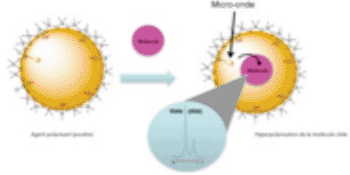
Image: Schematic of polarization process: Polarizing Agent (powder) (left), Molecule (red), Microwave (top), Nuclear Magnetic Resonance (bottom), Hyperpolarization of the targeted molecule (left) (Photo courtesy of the University of Lyon, France).
NMR has also known an exciting new advance in the medical field with the development of magnetic resonance imaging (MRI). Up to now, the DNP has been effectively applied to MRI for the early diagnosis of tumors in small animals (pigs and rodents) in preclinical research and more recently to 30 human patients having prostate cancers. However, MRI using DNP cannot be generalized to human diagnosis because polarizing agents used to activate biologic tracers/contrast agents need to be quantitatively separated from the polarized solution before human injection and image acquisition. This technical hurdle is now solved.
In this framework, an innovative powder for the easy polarization of many molecules, including biologic tracers, was developed in the frame of a European collaboration involving the University of Lyon’s laboratory of chemistry, catalysis, polymers and processes (UMR 5265-LC2P2), the European Center for High-Field NMR (UMR 5280, CRMN; Lyon, France) and ETH (Swiss Federal Institute of Technology) Zurich (Switzerland). These novel powders are creating tools for the fast characterization of complex systems by means of solid state NMR using DNP but also in the field of medical imaging for early cancer diagnosis using MRI. In this latter field, these agents can deliver a solution of polarized biologic tracers/contrast agents that are free from any impurity and therefore safe to inject in humans.
The research was published August 2013 in Journal of the American Chemical Society.
Related Links:
University of Lyon
European Center for High-Field NMR
ETH Zurich




Digital X-Ray Detector Panel
Acuity G4

Adjustable Mobile Barrier
M-458


Ultrasonic Pocket Doppler
SD1


Breast Localization System
MAMMOREP LOOP