New Proton Therapy Platform Integrates into Existing Radiotherapy Departments
Posted on 16 May 2026
Mevion Medical Systems (Littleton, MA, USA) has introduced the MEVION S250-FIT Proton Therapy System to the European radiation oncology community at ESTRO 2026, the first proton therapy platform designed for installation in a standard radiation therapy vault. The system is both U.S. Food and Drug Administration (FDA)–cleared and CE-marked under Regulation (EU) 2017/745. It is presented as a pathway for cancer centers to add proton therapy within existing LINAC-based treatment environments. The approach is intended to align with established infrastructure, workflows, and capital planning in modern radiotherapy departments.
The S250-FIT delivers intensity modulated proton therapy via Mevion’s HYPERSCAN pencil beam scanning with the Adaptive Aperture proton multi-leaf collimator and is designed to support DirectARC proton arc therapy. The system supports advanced image-guided and adaptive workflows and is FLASH research-ready. It is paired with Leo Cancer Care’s Marie Upright Patient Positioning and Computed Tomography (CT) Imaging System, described as the first commercial upright treatment platform with an integrated diagnostic CT, offering potential benefits in patient comfort and supporting organ motion management during treatment.
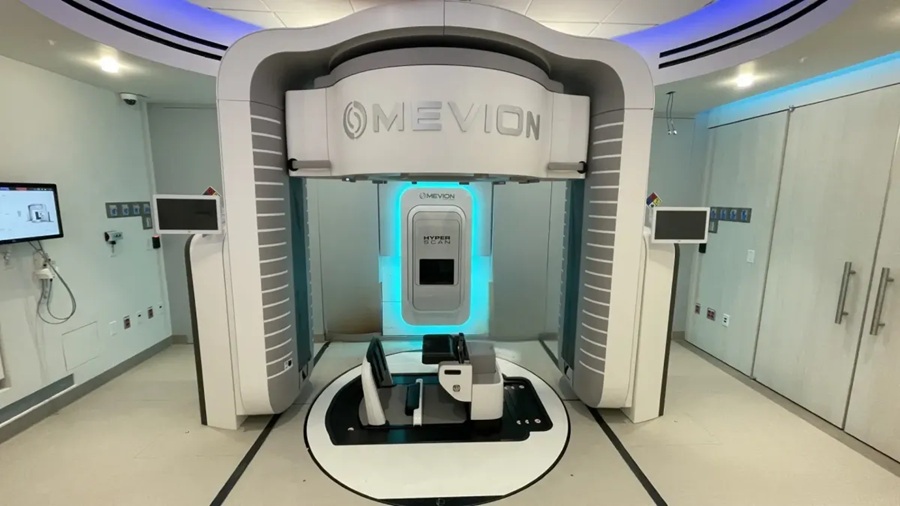
On April 7, 2026, Stanford Medicine unveiled the world’s first S250-FIT installation, developed in collaboration with Leo Cancer Care. The system was fully installed within a standard 110 m² (1,200 sq ft) LINAC vault inside the existing Stanford Medicine Cancer Center in Palo Alto, without constructing a new building. Mevion has signed contracts with nine institutions globally for the S250-FIT, including Stanford Health Care, Loma Linda University Health, UNC Health, BayCare Health System, Atlantic Health System, and the University of Nebraska Medical Center.
“With FIT™, proton therapy is no longer limited by infrastructure. For the first time, it can be deployed within the same clinical and operational framework as conventional radiotherapy. For European health systems that have long recognized the benefits of proton therapy but faced significant infrastructure and financial barriers, this changes the question from whether to build a separate proton facility to how to integrate proton therapy into the radiotherapy programs they already operate,” said Tina Yu, Ph.D., CEO and President of Mevion Medical Systems.
Related Links
Mevion Medical Systems