


Refining CREST MRI to Track Creatine in Heart Patients
By MedImaging International staff writers
Posted on 28 Jan 2014
A new magnetic resonance imaging (MRI) approach to map creatine at higher resolutions in the heart may help clinicians and scientists find abnormalities and disorders earlier than traditional diagnostic methods.Posted on 28 Jan 2014
Investigators from the Perelman School of Medicine at the University of Pennsylvania (Penn Medicine; Philadelphia, PA, USA) reported in a new study published online January 13, 2014, in the journal Nature Medicine that their preclinical findings show an advantage over less sensitive tests and point to a safer and more cost-effective strategy than those with radioactive or contrasting agents.
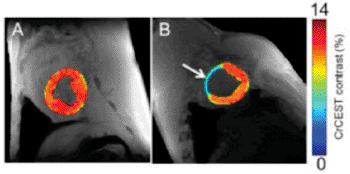
Image: Creatine CEST maps of healthy myocardium in a large animal (left). Eight week-old infarcted tissue, with noticeably less creatine (right). Arrow on right indicates infarcted region of heart tissue (Photo courtesy of Ravinder Reddy, PhD, Nature Medicine).
Creatine is a naturally occurring metabolite that helps supply energy to all cells through creatine kinase reaction, including those involved in contraction of the heart. Even in the very early stages, when heart tissue becomes injured from a loss of blood supply, creatine levels decrease. Researchers utilized this process in a large animal model with a technique called chemical exchange saturation transfer (CEST), which measures specific molecules in the body, to track the creatine on a regional basis.
The team, led by Ravinder Reddy, PhD, professor of radiology and director of the Center for Magnetic Resonance and Optical Imaging at Penn Medicine, discovered that imaging creatine through CEST MRI provides higher resolution compared to standard magnetic resonance spectroscopy (MRS), a typically used technique for measuring creatine. Its inferior resolution, however, makes it difficult to determine precisely which areas of the heart have been compromised.
Related Links:
Perelman School of Medicine at the University of Pennsylvania





Digital Radiographic System
OMNERA 300M

Digital Radiography System (Ceiling Free)
Digix CF Series

Floor‑Mounted Digital X‑Ray System
MasteRad MX30+
New

Radiology Monitor
Barco MDNC-12130 Nio Fusion 12MP Radiology Monitor