


AI Tool Enables Real-Time Diffuse Optical Tomography for Brain Lesion Detection
Posted on 11 Jun 2026
Diffuse optical tomography is a noninvasive imaging technique that uses near-infrared light to detect internal abnormalities such as cerebral hemorrhage and tumors. Its clinical utility for real-time decision-making has been limited by the need to solve computationally expensive light-transport equations during image reconstruction. These simulations can take hours, preventing real-time use. To help address this challenge, researchers have now developed an artificial intelligence model that accelerates the required predictions by more than a million-fold to enable real-time diagnosis.
Researchers at the University of Tsukuba (Tsukuba, Ibaraki, Japan) developed a neural network model for time-domain diffuse optical tomography (DOT). The model emulates light propagation in biological tissue by learning from large sets of physics-based simulations. It produces the forward predictions needed for image reconstruction without solving the radiative transfer equation.
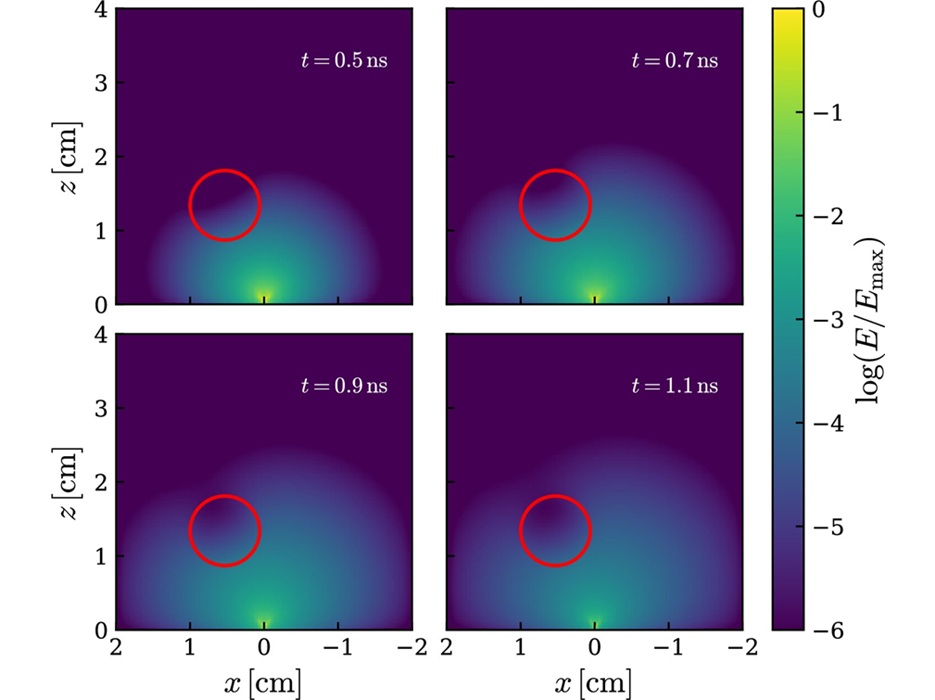
In DOT, tissue is illuminated with near-infrared light and detectors record time-resolved signals that reflect the presence of internal abnormalities without radiation exposure. High diagnostic accuracy requires modeling photon transport, but conventional numerical solvers can require hours per case. The new model predicts time-resolved detector signals directly from parameters describing the location and size of an abnormal region, removing the computational bottleneck.
Each inference completes in about 2 milliseconds, representing more than a million-fold speedup over standard simulations. The approach generalized to unseen parameter combinations and reproduced signals with accuracy limited only by the noise present in the training data. This acceleration enables efficient exploration of large parameter spaces during diagnostic analysis.
When combined with statistical sampling techniques, the model accurately estimated the location and size of abnormal regions from measured optical signals. The investigators highlight its potential as a foundational tool for real-time detection of cerebral hemorrhage and tumors. The work was published in Biomedical Engineering Letters.
Related Links
University of Tsukuba