


Targeted PET Platform Guides Osteosarcoma Resection and Margin Verification
Posted on 09 Jun 2026
Osteosarcoma, an aggressive primary bone cancer that mainly affects children and adolescents, demands wide excision to prevent local recurrence. Surgeons must achieve negative margins while preserving limb function, yet real-time margin definition remains difficult in complex musculoskeletal anatomy. Positive margins worsen outcomes and increase the need for additional therapy. To help address this challenge, researchers have developed an integrated positron emission tomography (PET) platform designed to rapidly distinguish tumor from normal tissue and guide precise resection.
Developed by researchers at Peking University Cancer Hospital and Institute and presented at the Society of Nuclear Medicine and Molecular Imaging (SNMMI) 2026 Annual Meeting, the platform integrates B7-H3–targeted imaging across the surgical pathway. It is built to support preoperative staging, intraoperative navigation, and postoperative margin verification in one end-to-end workflow. The approach aims to enable complete tumor removal while maintaining limb-sparing strategies.
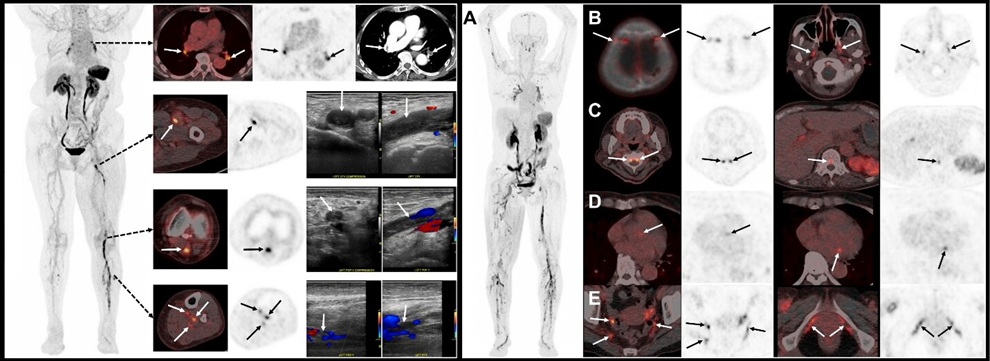
![Image: (A-C) Representative whole-body maximum-intensity projection images and regional fused PET/CT images from three histologically confirmed osteosarcoma patients who underwent paired [68Ga]Ga-B7-H3-BCH PET/CT and 18F-FDGE PET/CT within 7 days. (D) Multimodal imaging evaluation of patient 3, including X-ray, MRI (T2-weighted imaging, T2WI), CT, and B7-H3 PET/CT. (Photo courtesy of SNMMI)](https://globetechcdn.com/mobile_medicalimaging/images/stories/articles/article_images/2026-06-07/294811110_image_1.jpg "Image: (A-C) Representative whole-body maximum-intensity projection images and regional fused PET/CT images from three histologically confirmed osteosarcoma patients who underwent paired [68Ga]Ga-B7-H3-BCH PET/CT and 18F-FDGE PET/CT within 7 days. (D) Multimodal imaging evaluation of patient 3, including X-ray, MRI (T2-weighted imaging, T2WI), CT, and B7-H3 PET/CT. (Photo courtesy of SNMMI)")
The platform centers on the first B7‑H3–targeted radiotracer, 68Ga‑B7H3‑BCH, and a complementary near‑infrared B7‑H3 fluorescent probe. B7‑H3 is highly expressed in more than 80% of osteosarcoma cases, creating a specific target for both systemic staging and margin-level visualization. Researchers reported that 68Ga‑B7H3‑BCH demonstrated diagnostic performance that was significantly superior to clinically used tracers.
Preclinical work included cell-line and mouse‑model studies to assess lesion detectability. PET/CT in mice characterized tracer uptake around the tumor boundary, while near‑infrared fluorescence during simulated resection identified and validated margins. Histological comparisons were used to confirm accuracy. In this workflow, 68Ga‑B7H3‑BCH PET/CT noninvasively mapped B7‑H3 expression throughout the body for precise staging, and the near‑infrared probe provided high‑resolution, real‑time margin visualization. A rapid pathological margin verification technique completed margin assessment within 30 minutes.
Although the platform remains investigational, an ongoing PET imaging study has provided early feasibility evidence in patients. Representative clinical images showed whole‑body and regional PET/CT from three histologically confirmed patients who underwent paired 68Ga‑B7H3‑BCH and 18F‑FDG PET/CT within seven days. Further prospective clinical validation, safety assessment, regulatory review, and workflow optimization are required before clinical adoption. The approach is intended to reduce local recurrence risk and preserve limb function by enabling more accurate resections.
“Despite continuous advances in surgical techniques, orthopedic surgeons still face a major challenge: how to delineate tumor margins accurately during surgery so as to ensure complete tumor removal while maximizing preservation of limb function,” said Bo Mei, Ph.D., of Peking University Cancer Hospital and Institute in Beijing, China.
“The development and clinical translation of this integrated platform will facilitate a paradigm shift in osteosarcoma care, from empirical ‘surgery plus systemic chemotherapy’ to individualized, precision, closed-loop diagnosis and treatment carrying major clinical and scientific significance,” said Mei.
Related Links
Peking University Cancer Hospital and Institute
SNMMI