


Focused Ultrasound Technique Successfully Treats Pediatric Brain Cancer
Posted on 22 Dec 2025
Treating brain cancer in children remains one of the most difficult challenges in medicine, largely because most chemotherapy drugs cannot reach tumors deep inside the brain. A key obstacle is the blood-brain barrier, a protective shield that blocks toxins but also prevents lifesaving cancer drugs from entering brain tissue. As a result, survival rates for aggressive pediatric brain cancers such as diffuse midline glioma have remained largely unchanged for decades. Now, a new clinical study shows that a noninvasive ultrasound-based approach can safely open this barrier in children, allowing chemotherapy to reach brain tumors.
In the study, researchers at Columbia University (New York City, NY, USA) tested focused ultrasound, a technique that uses targeted sound waves to temporarily loosen the blood-brain barrier, in pediatric brain cancer patients. Unlike conventional approaches that require MRI-guided procedures, the Columbia engineers developed a system that delivers focused ultrasound outside the MRI scanner. MRI images are obtained beforehand for planning, while the ultrasound treatment itself is performed in a more comfortable, child-friendly setting with family members present.
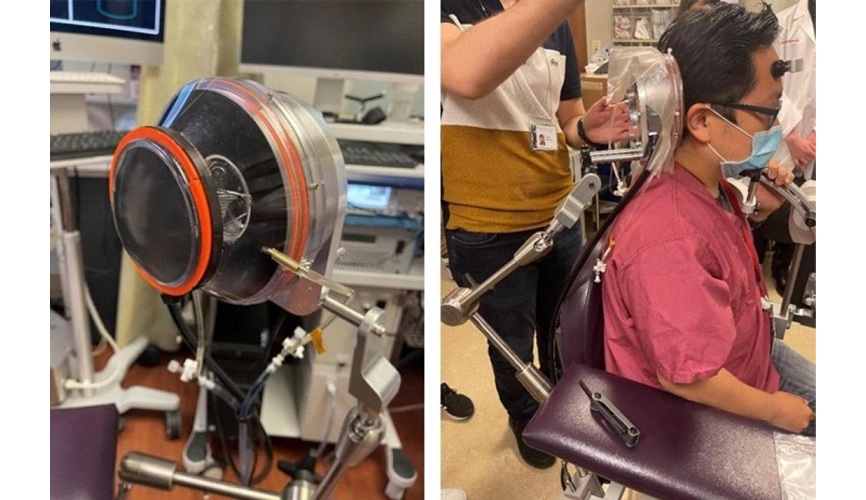
Focused ultrasound works by activating tiny, lipid-coated gas bubbles circulating in the bloodstream. When exposed to sound waves, these bubbles expand and contract, gently prying open microscopic pathways in the blood-brain barrier so drugs can pass through. The barrier then reseals after treatment, restoring its protective function. In this study, focused ultrasound was combined with chemotherapy to enhance drug delivery directly to tumors located deep within the brainstem, areas that are otherwise nearly impossible to treat effectively.
The technique was tested in three children with diffuse midline glioma, a rare and universally fatal pediatric brain cancer. In all three patients, focused ultrasound successfully opened the blood-brain barrier, allowing chemotherapy to reach the tumor site. Some improvement in mobility was observed, demonstrating the biological and clinical effects of the treatment. While all three children ultimately died from their disease or complications related to COVID, the study established that the procedure was safe and feasible in pediatric patients, marking a critical first step toward broader clinical use.
By confirming safety in children, the findings, published in Science Translational Medicine, open the door to future trials that could apply focused ultrasound earlier in the disease course and with optimized drug dosing. The researchers have already launched a follow-up clinical trial combining focused ultrasound with etoposide, an FDA-approved chemotherapy drug with known activity against brain cancer cells. More broadly, the approach could transform how brain cancers are treated by enabling existing cancer drugs to reach tumors that were previously inaccessible, potentially improving survival in diseases where progress has long stalled.
“Now that we’ve established the safety and feasibility of focused ultrasound in children, we’ve opened the door for more trials to try the technique earlier in the course of the disease and with lower systemic but higher brain doses,” said study leader Stergios Zacharoulis, MD. “Our hope is that the technology will improve survival for children with brain cancer.”
Related Links:
Columbia University