


New Algorithm Dramatically Speeds Up Stroke Detection Scans
Posted on 16 Dec 2025
When patients arrive at emergency rooms with stroke symptoms, clinicians must rapidly determine whether the cause is a blood clot or a brain bleed, as treatment decisions depend on this distinction. Presently, this diagnosis relies on large CT scanners that are not available in ambulances, rural clinics, or many hospitals worldwide, often delaying life-saving care. Now, a new computational advance shows that brain imaging using microwaves can be reconstructed fast enough to support real-time clinical decision-making without radiation or bulky infrastructure.
In research led by NYU Tandon School of Engineering (Brooklyn, NY, USA), the team focused on microwave imaging, a technique that detects changes in the electrical properties of brain tissue that occur during stroke, swelling, or tumor growth. Rather than redesigning hardware, the researchers rethought the mathematical framework behind image reconstruction. Their approach allows early-stage approximations instead of demanding perfect accuracy at every step, reducing the number of computationally intensive electromagnetic calculations while maintaining image stability even for complex head geometries.
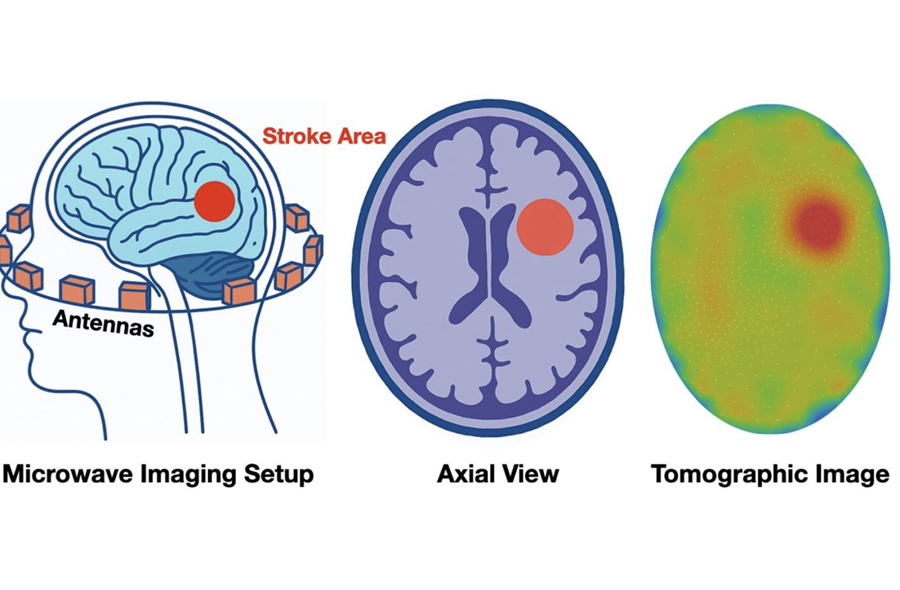
The algorithm was tested using simulated data and real experimental measurements, including cylindrical targets scanned with a microwave imaging system. Image reconstructions that previously required up to an hour were completed in under 40 seconds, representing a 10–30× speed improvement. The findings, published in IEEE Transactions on Computational Imaging, show that despite the dramatic reduction in computation time, the reconstructed images retained high quality and accuracy. The method consistently produced reliable results across datasets, demonstrating that rapid microwave image reconstruction is feasible without sacrificing performance.
Faster reconstruction removes one of the main barriers preventing microwave imaging from entering clinical practice. Portable systems could enable stroke diagnosis in ambulances, monitor brain swelling in intensive care units without repeated CT scans, or provide low-cost breast cancer screening alternatives in resource-limited settings. The researchers are now working to extend the method to full three-dimensional imaging, a key step toward real-world deployment. With continued development, microwave tomography could evolve from a laboratory technology into a practical diagnostic tool.
“You can’t wait up to an hour to know if someone is having a hemorrhagic stroke,” said Stephen Kim, Research Professor, Department of Biomedical Engineering, NYU Tandon School of Engineering. “We’re taking a technology that has been stuck in the lab for years and giving it the speed it needs to matter clinically.”
“We always knew microwave imaging had the potential to be portable and affordable. But without rapid reconstruction, the technology couldn’t make the leap into real clinical settings,” said Department Chair Andreas Hielscher. “Now we’re finally closing that gap.”
Related Links:
NYU Tandon School of Engineering