


Breast Imaging Software Enhances Visualization and Tissue Characterization in Challenging Cases
Posted on 06 Apr 2026
Breast imaging can be particularly challenging in cases involving small breasts or implants, where image reconstruction and tissue characterization may be limited. Clinicians also need reproducible analysis and efficient workflows across a broad range of patient anatomies. Multimodal acoustic information can improve visualization and interpretation when combined effectively. A new software update now offers higher-resolution reflection imaging and fused speed-of-sound/reflection outputs to support image interpretation.
QT Imaging Holdings, Inc. has released version 4.5.0 of its breast imaging reconstruction software. The update targets cases that are difficult to image and aims to improve overall performance. It is intended for use by clinicians and researchers seeking more detailed visualization and quantitative information during image review.
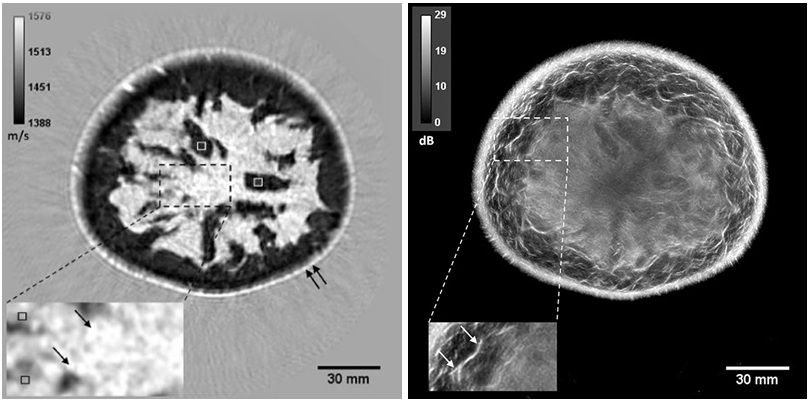
The software enhances spatial resolution in reflection imaging by implementing optimized, spatially varying deconvolution during reflection image reconstruction, which is designed to yield more accurate image representation while maintaining efficient processing times. It also generates enhanced reflection images through fusion of speed-of-sound and reflection data. Together, these changes are described as improving visualization and supporting comprehensive, reproducible analysis across a wide range of cases.
Additional updates include improved image reconstruction for small breasts and more accurate assessment of fibroglandular tissue composition in breasts with implants, broadening applicability across patient anatomies. The company is also advancing the development of attenuation as an additional quantitative biomarker to complement speed of sound and reflection intensity, with the integration expected to further enhance tissue characterization and provide added quantitative information for analysis and decision support. Overall, the release is positioned as an incremental step toward improved image quality, clinical reliability, and workflow efficiency.
"The enhanced reflection images represent a meaningful improvement in image quality and usability. Combining reflection with speed of sound information provides additional insight that was not previously available from reflection imaging alone," said Dr. John Tentinger, President and Chief Executive Officer at Innovative Radiology, a radiology center in West Des Moines, Iowa, and a QT Imaging customer.
"Building on our multimodal imaging approach, we are advancing the development of attenuation as an additional quantitative biomarker, to complement speed of sound and reflection intensity. The integration of attenuation is expected to further enhance tissue characterization capabilities and provide clinicians and researchers with additional quantitative information for improved analysis and decision support," said Dr. James Wiskin, QT Imaging Fellow.
Related Links
QT Imaging Holdings, Inc