


AI Reconstruction Tool Speeds Dynamic Breast MRI and Improves Cancer Detection
Posted on 29 Jun 2026
Breast cancer affects about 2.3 million people each year, creating sustained demand for precise imaging. Dynamic magnetic resonance imaging (MRI) is highly sensitive, yet slow acquisitions hinder real-time tracking of contrast kinetics and strain scanner capacity. Prolonged scans can also affect patient comfort and throughput. To help address this challenge, researchers have now developed an artificial intelligence–enabled approach that accelerates dynamic breast MRI while maintaining diagnostic detail.
Called ELITE, the method was developed by Technion - Israel Institute of Technology with U.S. collaborators. It combines advanced mathematical modeling with a deep neural network (ResNet) trained to suppress noise and artifacts. The system also reconstructs missing information from undersampled measurements to preserve spatial detail at high speed. Traditional exams yield one image every one to two minutes, whereas ELITE produces roughly one image per second.
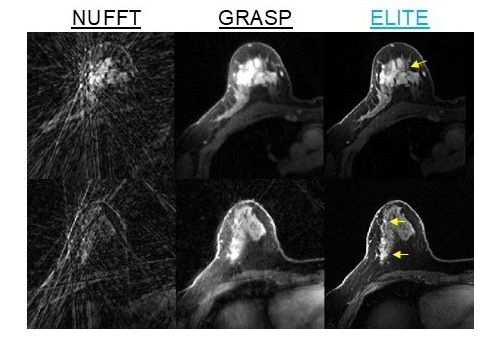
Dynamic MRI is used chiefly for screening women at high risk for breast cancer and is noted for more than 90% accuracy, compared with approximately 50%–60% for ultrasound and mammography combined. In a study involving 54 patients, the method improved tumor conspicuity over existing reconstructions, delivered exceptionally high image quality, and achieved high diagnostic sensitivity. The near-continuous depiction of contrast movement is intended to aid detection of small lesions, refine differentiation of benign and malignant findings, and better characterize tissue perfusion and vascular permeability.
The project included contributors from Weill Cornell Medical College and the New York University Center for Advanced Imaging Innovation and Research. It follows prior work that created a repository of 300 breast MRI scans to support development of artificial intelligence methods. The study was published in Nature Communications on May 19, 2026. The team reports that shorter scans could expand access on existing scanners, and demonstrations suggest applicability to brain as well as head and neck imaging, with potential extensions to other imaging platforms.
Related Links
Technion - Israel Institute of Technology
Weill Cornell Medical College